Showing posts with label Meditation. Show all posts

Monday, October 20, 2014

The Inner-Child and Our Physical Body

The inner-child may also be referred to as the subconscious mind or the Unihilipi. Most of us have never given it (inner-child) a moments thought. We live our lives immersed in external stimuli and spend little to no time to check-in with our inner-self. 

Being neglectful of our internal state of affairs is deterimemtal to our physical and psychological wellbeing. 

Our subconscious is responsible for the function of the involuntary systems of our bodies. It also holds all of our memories, experiences and thoughts from the beginning of our creation. The concious mind is generally unaware of the workings of the subconscious yet it (the conscious mind) is directed and sustained by the the subconscious. 

"The autonomic nervous system (ANS or visceral nervous system or involuntary nervous system) is the part of the peripheral nervous system that acts as a control system that functions largely below the level of consciousness to control visceral functions, including heart rate, digestion, respiratory rate, salivation, perspiration, pupillary dilation, micturition (urination), sexual arousal, breathing and swallowing. Most autonomous functions are involuntary but they can often work in conjunction with the somatic nervous system which provides voluntary control."

It is important to spend time everyday with your innerself. You don't need to be a Reiki Master, Yoga Master or Guru to connect with your inner-child. You just need an open mind guided by an open heart and a commitment to love. 

Here is a simple exsersise I do with my energetic meditation group to connect with our inner-child about our physical bodies. If you are inspired you can try it at home on your own. 

Meditation for connection to the physical self

Preparation: 
Make sure you are well hydrated and well rested prior to meditation. Find a place where you will not be disturbed. Turn your electronics off. (Mobil phone, computer, etc) Find a comfortable position either seated or laying-down  (If at anytime you become dizzy or you experience "the spins" just open your eyes and look straight ahead. Don't move until the dizziness subsides.)

1. Close your eyes. 

2. Inhale deeply into your belly slowly. Fell your belly rise. 


3. Hold the breath for a moment. 


4. Exhale the breath slowly. Feel your belly flatten. 


5. Hold the emptiness for a moment. 


6. Repeat until you feel your body and mind in a relaxed state. (Careful not to make yourself "light-headed".)


7. Once you are in a more relaxed state begin to check-in with your physical body. Visualize your body from head to toe and scan for any pain, discomfort, or tension. 

8. Each time you find a place that feels a difficulty, breath in a deep cleansing breath filled with white light. If the pain is in your foot, direct the breath to your foot. Bring white light to the area with every inhale and let the pain and stress leave your body with every exhale. Remember that love is a powerful healing tool. Make "I love you" and "Thank you" your mantra as your breath in cleansing white light and exhale that which no longer serves. 

9. Continue to check-in throughout your entire body. Spend as much time as needed in each area. 
Take your time, there is no rush.


10. Complete breathing meditation by inhaling white light through the top of our head and bring the breath down your spine through your legs and exhaling out the bottoms of your feet.


11. Thank your subconscious for guiding your conscious attention to the places in your body that needed healing, love and balance. 


12. Remember to drink plenty of water and keep your love and gratitude mantra (mentally repeating, I love you & Thank you) going throughout the day.

Wednesday, October 1, 2014

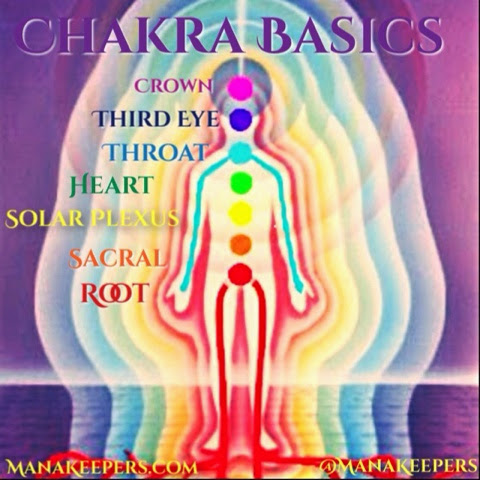
Chakra Basics

Chakra is a Sanskrit word that translates as wheel or disc. A chakra is a center of activity that receives, assimilates, and expresses life force energy. The chakras are like spinning spheres of bioenergetic activity emanating from the major nerve ganglia branching forward from the spinal column. Six of these wheels are located in a column of energy that spans from the base of the spine to the middle of the forehead. The seventh is beyond the physical region above the head. Each chakra in your spinal column is believed to influence or even govern bodily functions near its region of the spine. 


Seven major chakras or energy centers exist, located within the subtle body. Practitioners of Hinduism learn that the chakras interact with the body's ductless endocrine glands and lymphatic system by feeding in good bio-energies and disposing of unwanted bio-energies. 
Much of the original information on Chakras comes from the "Upanishads", which are difficult to date because they were passed down orally for approximately a thousand years before being written down for the first time between 1200–900 BCE.

The Seven Major Chakras

Muladhara: The Base Chakra or root chakra is related to instinct, security, survival and also to basic human potentiality. This centre is located in the region between the genitals and the anus. Although no endocrine organ is placed here, it relates to the gonads and the adrenal medulla, responsible for the fight and flight response when survival is under threat. In males, there is a muscle located in this region that controls ejaculation. A parallel is charted between the sperm cell and the ovum where the genetic code lies coiled and the kundalini. Muladhara is symbolised by a lotus with four petals and the colour red. Key issues involve sexuality, lust and obsession. Physically, Muladhara governs sexuality, mentally it governs stability, emotionally it governs sensuality, and spiritually it governs a sense of security.


Svadisthana: The Sacral Chakra is located in the sacrum and is considered to correspond to the testes or the ovaries that produce the various sex hormones involved in the reproductive cycle. Svadisthana is also considered to be related to the genitourinary system and the adrenals. The Sacral Chakra is symbolized by a lotus with six petals, and corresponds to the color orange. The key issues involve relationships, violence, addictions, basic emotional needs, and pleasure. Physically, Svadisthana governs reproduction, mentally it governs creativity, emotionally it governs joy, and spiritually it governs enthusiasm.


Manipura: The Solar Plexus Chakra is related to the metabolic and digestive systems. Manipura corresponds to Islets of Langerhans, which are groups of cells in the pancreas, as well as the outer adrenal glands and the adrenal cortex. These play a valuable role in digestion, the conversion of food matter into energy for the body. Symbolised by a lotus with ten petals. The color that it corresponds to is yellow. Key issues governed are issues of personal power, fear, anxiety, opinion-formation, introversion, and transition from simple or base emotions to complex. Physically, Manipura governs digestion, mentally it governs personal power, emotionally it governs expansiveness, and spiritually, all matters of growth.


Anahata: The Heart Chakra is related to the thymus, located in the chest. The thymus is an element of the immune system as well as being part of the endocrine system. It produces the T cells responsible for fending off disease and may be adversely affected by stress. Anahata is symbolised by a lotus flower with twelve petals. Anahata is related to the colors green or pink. Anahata involve complex emotions, compassion, tenderness, unconditional love, equilibrium, rejection and well being. Physically Anahata governs circulation, emotionally it governs unconditional love for the self and others, mentally it governs passion, and spiritually it governs devotion.


Vishuddha: The Throat Chakra relates to communication and growth through expression. This chakra is paralleled to the thyroid, a gland that is also in the throat and which produces thyroid hormone, responsible for growth and maturation. Symbolised by a lotus with sixteen petals. Vishudda is characterized by the color light or pale blue, or turquoise. It governs such issues as self-expression and communication. Physically, Vishuddha governs independence, mentally it governs fluent thought, and spiritually, it governs a sense of security.


Ajna: The Brow Chakra (also known as the third eye chakra) is linked to the pineal gland. The pineal gland is a light sensitive gland that produces the hormone melatonin which regulates sleep and awakening. Ajna is symbolised by a lotus with two petals, and corresponds to the color white, indigo or deep blue. Ajna's key issues involve balancing the higher & lower selves and trusting inner guidance. Ajna's inner aspect relates to the access of intuition. Emotionally, Ajna deals with clarity on an intuitive level.

Sahasrara: The Crown Chakra is generally considered to be the chakra of pure consciousness. Its role is somewhat similar to that of the pituitary gland, which secretes hormones to communicate to the rest of the endocrine system and also connects to the central nervous system via the hypothalamus. The thalamus is thought to have a key role in the physical basis of consciousness. Symbolized by a lotus with one thousand petals, it is located at the crown of the head. Sahasrara is represented by the color violet and it involves such issues as inner wisdom and the death of the body. Sahasrara's inner aspect deals with the release of karma, physical action with meditation, mental action with universal consciousness and unity, and emotional action with "beingness"


Endocrine system
The primary importance and level of existence of chakras is in the psyche. However, chakras have a physical manifestation as well. There is a relationship between the positions and functions of the chakras and of the various organs of the endocrine system. There is a marked similarity between the positions and roles of the chakras, and the positions and roles of the glands in the endocrine system, and also by the positions of the nerve ganglia (also known as "plexuses") along the spinal cord (branching to plexuses by endocrine glands or organs), interconnecting the two systems. Chakras have their physical manifestation in the body as these glands and their subjective manifestation as the associated emotional, mental, and spiritual experiences.


Thank you for visiting. Wishing you Peace today and everyday.


POI

Wednesday, April 3, 2013

The Reiki Principles


The Reiki Principles

The Reiki Principles, or precepts, were thought to have been the words of Meiji, who was born Prince Mutsuhito, and became the emperor of Japan from 1867 to 1912. Meiji means “enlightened rule” and it was during this time in Japan's history, that Japan became a modernized, industrial power.

The confusion about who wrote The Reiki Principles, comes from the fact that Dr. Usui's memorial references the Emperor's admonitions, in addition to mentioning The Reiki Principles. By referencing the Emperor's admonitions, people thought the Emperor himself had written The Reiki Principles.

It is now believed that Dr. Usui created The Reiki Principles -"Usui Sensei created (the) Gokai (the 5 principles) getting hints from a book "Kenzon no Gebri" written by Dr. Bizan Suzuki (published in March, 1914.) The book says "Just for today, do not get angry, do not feel fear, be honest, work hard, and be kind to others."

It could be said, then, that Dr. Usui adopted the idea for The Reiki Principles from viewing Dr. Suzuki's book, and thus, Dr. Usui created The Reiki Principles.

It is thought that Dr. Usui's memorial referred to the Emperor's admonitions out of great respect for the Meiji, and also to show that The Reiki Principles were to be thought of as an addition to the Emperor's words, and not a replacement for the Emperor's words. (In 1890, the Meiji had presented a written document to his people known as the Imperial Rescript on Education. This declaration was a guideline for the way in which the people of Japan were asked to behave towards each other, further their education, and live their lives.

What do we know about the man who wrote The Reiki Principles? Born thirteen years after the birth of the Emperor, he was a respected Sensei, i.e., teacher, named Mikao Usui (August 15, 1865). His memorial states that he studied abroad, was knowledgeable on a variety of subjects, and often meditated at Mt. Kurama. During his lifetime, he held many positions/jobs, married, and had two children.

However, Dr. Usui was much more than that. He was a man who wished to become spiritually enlightened. After many years of research and searching for answers, his quest took him to Mt. Kurama, where he fasted and meditated for 21 days. On the last day of his fast, he felt one large Reiki over his head and he achieved Satori (the state of Spiritual Enlightenment). When he achieved enlightenment, he acquired an ability to heal, which he called 'Reiki Ryoho'.

Reiki (pronounced Ray-Key) means 'spiritual energy'; Ryoho means 'healing method'. This method of healing is called Usui Reiki Ryoho, or Reiki Ryoho; the short name for it is Reiho. Usui Sensei used this healing method on himself and on his family. Then, he decided to share his healing method with the public. In April, 1922, Usui Sensei founded the Reiki Method Learning Society. Dr. Usui practiced, taught, and gave Reiki to others until the end of his life on March 9, 1926.

There are several versions of the Reiki Principles. The version that I like best is the one that begins with the words Just For Today at the beginning of each line. Click here to go to a website to view this version of The Reiki Principles. The author at that website also offers her interpretation of The Reiki Principles, how they relate to one's life, and particularly to the life of a Reiki practitioner.

The Reiki Principles are easy to understand, but difficult to put into practice, especially on a daily basis. They are words that encourage us to think and evaluate how we live our lives, i.e., how we choose to live our lives. Dr. Usui thought that if you applied these principles, along with receiving Reiki, that you would have the "secrets of happiness" for the mind, body, and soul.

Excerpt taken from Laura Bullack in Reiki Just For Today – Thank you, Laura.

Thank you for visiting. Wishing you Peace today and everyday.


POI

Interview with Dr. Masaru Emoto of Messages from Water, Vol. 1

Interview with Dr. Masaru Emoto about the effects of his discovery for us in daily life. Great overview of his work as it correlates with resonance. Fuzzy images but worth watching. I love you and thank you H2O.


Thank you for visiting. Wishing you Peace today and everyday.


POI